How Control Surfaces Work
It is a common misconception that control surfaces work by simply “deflecting air.” Control surfaces do deflect air, but not by merely hanging out in the breeze so the airstream strikes the surface and is redirected. Most control surfaces are displaced by incredibly small amounts at most flying airspeeds, yet they still produce strong forces that change the attitude of the aircraft.
It is the change in angle of attack created by the control surface that causes an acceleration of the air perpendicular to the relative wind, producing lift or an aerodynamic force substantially greater than a simple deflection effect. This is the key idea behind how these surfaces actually work. See the following discussion and diagrams.
Control Surfaces
Rudder, elevator, and trim tabs all operate on the same aerodynamic principles. The horizontal and vertical stabilizers are typically symmetric airfoils, which have a symmetric pressure distribution and produce zero lift at zero degrees angle of attack. When the elevator or rudder is displaced, the chord line changes and these airfoils can efficiently produce lift in either direction.
Cambered airfoils can also produce lift in either direction, but they require significant angle of attack below zero to produce negative lift. It is another common misconception that the displacement of the control surface simply causes the airstream to impact and deflect, producing the required pitch or yaw moments. In reality, the force generated by direct impact of the free airstream against a displaced control surface is very small compared with the lift force generated through the angle of attack created by that same control surface.
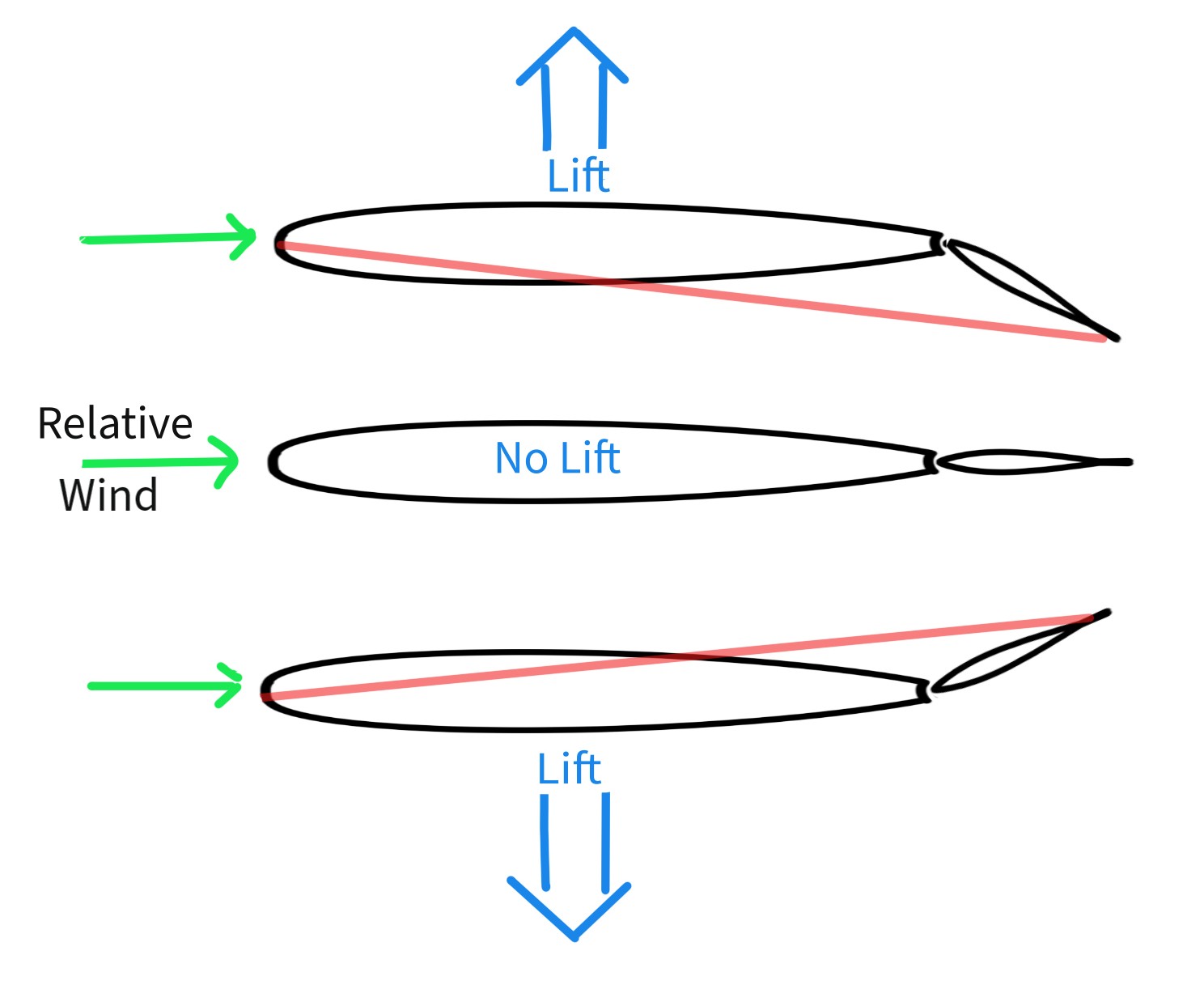
Figure 25
Trim tabs work in the same way as other control surfaces. However, trim tabs move opposite the desired primary control surface direction. In the diagram below, the local negative angle of attack moves the elevator down until it reaches equilibrium with other aerodynamic forces or reaches zero local angle of attack. The elevator then displaces downward, causing the angle of attack to increase in the horizontal stabilizer. This creates lift in the upward direction on the horizontal stabilizer, moving the tail up and the nose down as the aircraft rotates around its center of gravity.
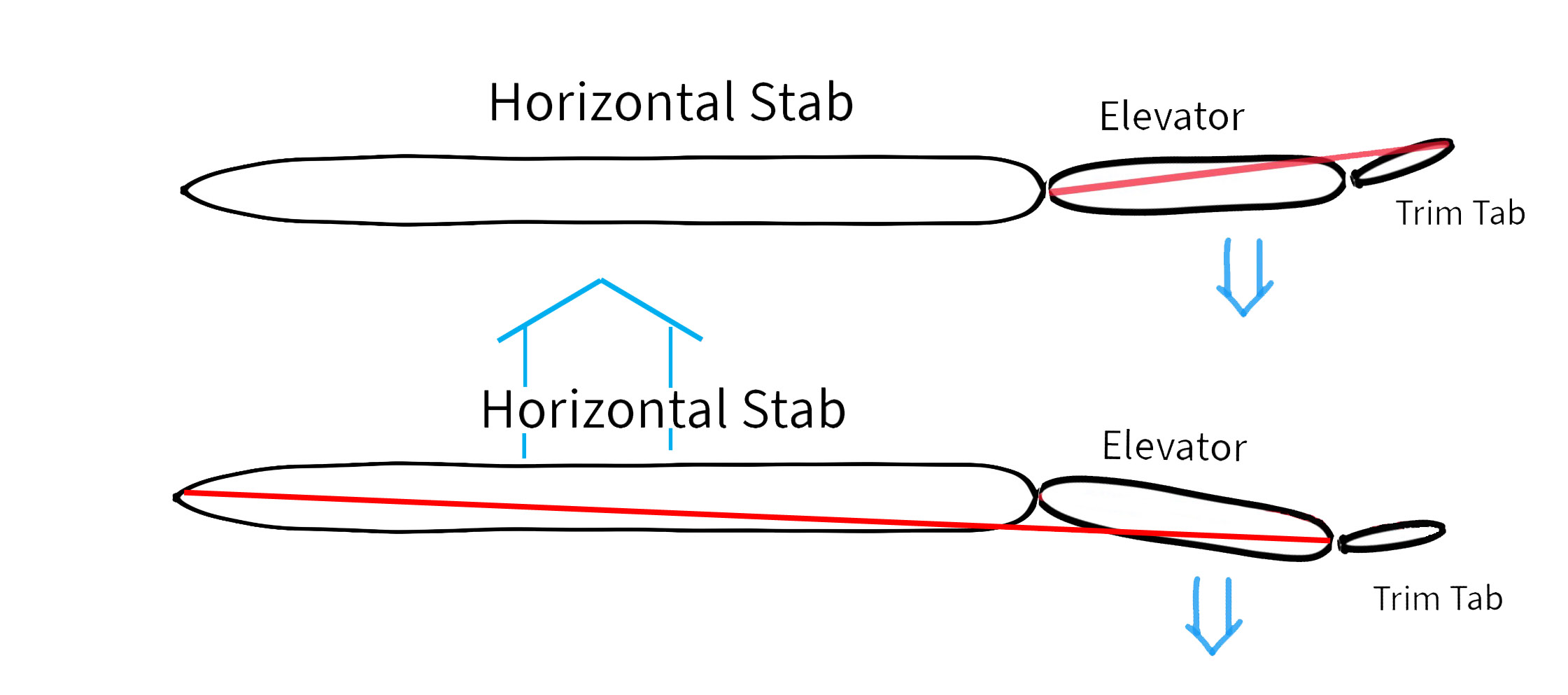
Figure 26
The elevator changes the pitch of the aircraft relative to the head and feet of the pilot. If the aircraft is in level flight, moving the controls aft moves the nose up toward the pilot’s head. Moving the controls forward moves the nose down toward the pilot’s feet. In a 90° bank, moving the control aft moves the nose inside the turn, while moving the control forward moves the nose outside the turn. In a level 45° bank, moving the control aft moves the nose toward the pilot’s head, which results in an equal amount of nose travel vertically and horizontally into the turn.
In all cases, there is a turning of the aircraft along the axis between the pilot’s head and feet. Turning flight includes a curved flight path in the horizontal plane, the vertical plane, and anywhere in between. This is directly related to the loads experienced in turns.
The elevator is the primary control of angle of attack and load in most regimes of flight. In positive-G flight, moving the control aft increases load and angle of attack, while moving it forward reduces load and angle of attack. The opposite is true for inverted, negative-G flight. In either case, the change in load is produced by turning flight.
For example, as we pitch up to a climb attitude, there is a brief period of turning flight where both the angle of attack and load factor increase. This is commonly experienced if the aircraft is rotated briskly on takeoff and the stall warning horn chirps. Once the pitch attitude and climb rate stabilize, the aircraft is no longer turning and the load factor returns to 1. Similarly, in level flight or during stall recovery, if we pitch down briskly, we enter a brief moment of turning flight with a load factor opposite gravity, experienced as negative Gs and a light feeling in the seat.
If we roll into a bank, the horizontal component of lift initiates a turn and increases the load on the aircraft. However, the elevator remains the primary control of angle of attack and load. While in a level turn, if we pull the control stick aft, we increase angle of attack and total lift. This tightens the turn by increasing the rate of turn and decreasing the turn radius.
Rudder, Roll, and Coordination
Application of the rudder produces a side force by increasing angle of attack to yaw the aircraft. There is a complex interaction of aerodynamic forces that induces a roll in the same direction as the yaw. For a detailed discussion of the factors involved, see John Denker’s discussion at AV8n.com.
The rudder controls yaw and therefore affects slips, skids, coordination, and the direction of the aircraft on solid surfaces.
Understanding control surfaces means understanding that the real force comes from aerodynamic lift created by angle of attack, not simple air deflection.
From the Flight Instructors Training Manual, Aerodynamics for the CFI, Fred A Sweet